
In a study of 199 fifth-grade students, children correctly answered only about half of the questions on finding and critically evaluating information.
Source 1
Your first detective case is free
Your child thinks they’re solving a mystery.
Your child thinks they’re solving a mystery.
You know they’re learning.
Turn reading, research, and critical thinking into an adventure with Detective Booksy.
Elementary-friendlyTeacher-createdLearn · Practice · Apply
Case file 001Curiosity is evidence that learning has already begun.
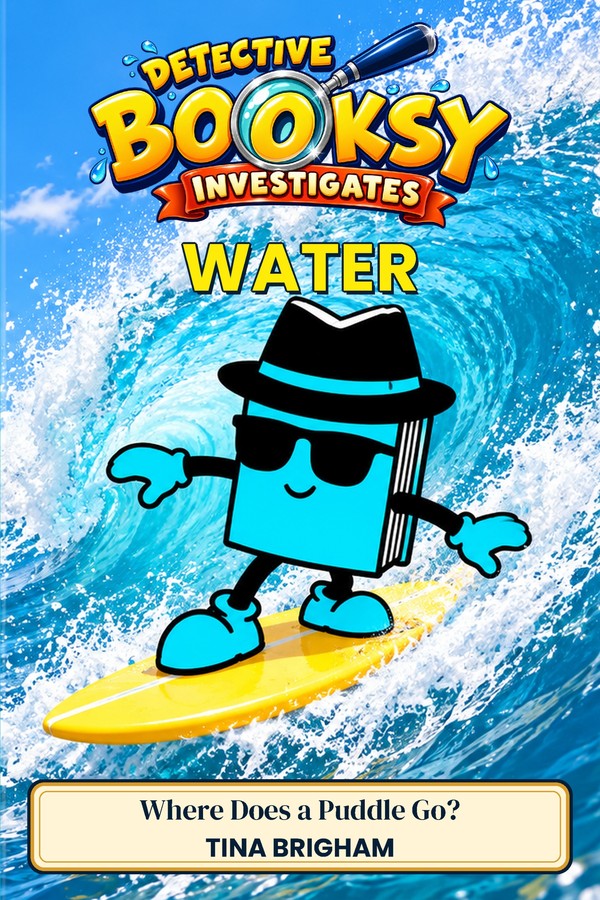
New from Detective Booksy Publishing
A puddle has vanished. Booksy is on the case!
Explore water, follow the clues, and try a puddle investigation of your own in Detective Booksy Investigates: Water — Where Does a Puddle Go?
Buy the paperback on AmazonChapter one · The spark
A child asks, “Why?”
That question is not an interruption. It is the beginning of an investigation.
Children are natural researchers. They notice, wonder, compare, test, and ask again. But too often, research becomes a copied paragraph, a last-minute report, or a search box followed by the first answer on the screen.
Detective Booksy begins somewhere better: with the child’s own question.
Chapter two · The new information world
Answers are everywhere. Judgment is not.
Today’s children can reach more information in seconds than previous generations could find in an afternoon. Search engines and AI can produce an answer instantly—but they cannot replace the habits of a thoughtful researcher.
Finding is not understanding.Children need a plan for turning a big curiosity into focused, researchable questions.
Visible is not verified.They need practice checking authors, evidence, purpose, date, and agreement across sources.
Copying is not learning.They need tools for taking notes, connecting ideas, citing sources, and explaining discoveries in their own words.
Evidence board · What the research says
Research skills belong in elementary school.
The evidence points to both an urgent need and a hopeful conclusion: children can improve when the research process is taught explicitly and practiced with support.
ACADEMIC
RESEARCH
REVIEWED
RESEARCH
REVIEWED
Percentage-point gains were recorded across planning, searching, and using information after 150 students completed a term-long guided inquiry project.
Source 2Among the Grade 5 students with available data, information-literacy scores were positively correlated with reading achievement.
Source 2Assessment results from 1,389 Kansas schools linked higher, more stable school-librarian staffing with higher proficiency rates.
Source 3These studies differ in setting and design. The Kansas findings are associations and do not by themselves prove causation; together, the studies support early, explicit instruction and meaningful access to library expertise.
Chapter three · The detective method
F.A.C.T. turns curiosity into capability.
Detective Booksy gives children a four-part research process they can use again and again—at school, in the library, and whenever the world makes them wonder.
Focus on a Topic
Choose what you want to investigate and narrow it to fit the project.
Ask Questions
Decide what you want to find out about your focused topic.
Choose and Cite Sources
Find trustworthy, useful sources and record where the information came from.
Take Notes
Write important facts in your own words and connect each fact to its source.
The goal is not to hand children every answer. It is to help them become the kind of people who can find one.
Learning they can own
When children understand the research process, the adult no longer has to carry every investigation. Students begin to:
- follow their own interests with purpose;
- persist when the first search does not work;
- question surprising or suspicious claims;
- connect reading, writing, science, and social studies; and
- see themselves as capable thinkers with something to contribute.
Chapter four · Welcome to the Academy
Instruction first. Adventure next. Independence always.
The Academy organizes every resource into one clear learning journey.
LEARN
Short lessons, videos, slide presentations, workbooks, and teacher guides build the core skills.
- Ask research questions
- Choose and cite sources
- Take useful notes
- Check facts and evidence
PRACTICE
Mysteries, missions, games, and library challenges make repetition feel like solving a case.
- 59 research mysteries
- 50 library missions
- Dewey Decimal games
- Printable practice activities
APPLY
Research projects invite students to follow the complete process and create something meaningful.
- Animal and science questions
- History and geography
- Editable project templates
- Growing investigation library
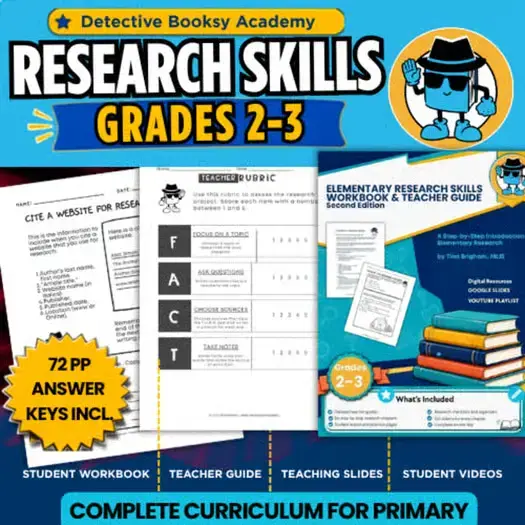 Elementary Research Skills Workbook
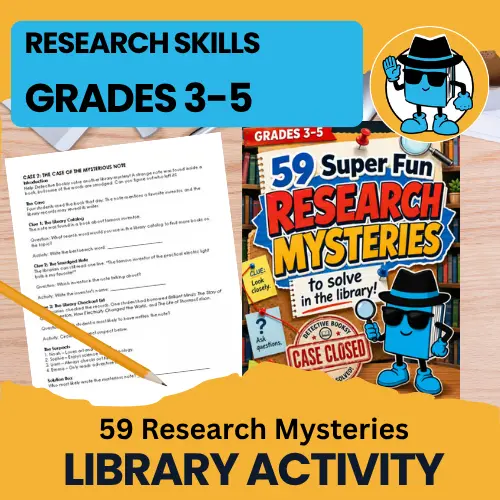 59 Research Mysteries
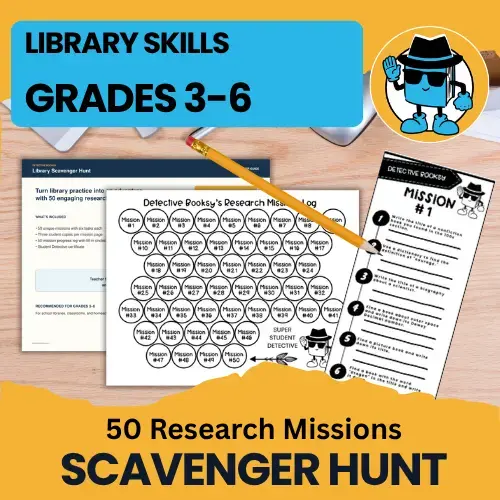 50 Research Missions
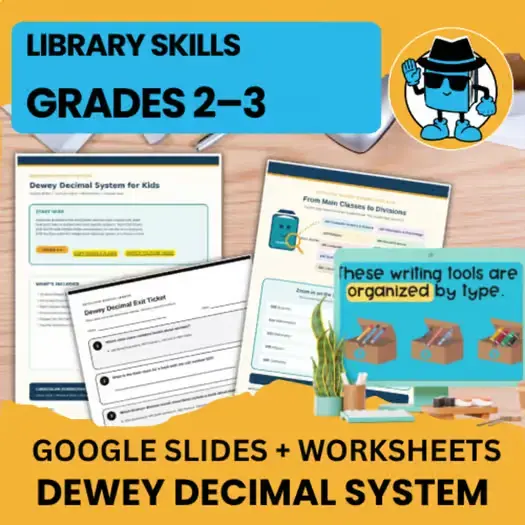 Dewey Decimal System for Kids
The founding class
Help build the Academy from the beginning.
Founding members receive lifetime access to the Academy at its lowest planned price. As the library grows, the public price will grow with it—but your founders price stays yours.
1 · PurchasePurchase your Founding Member access here or from the Detective Booksy store.
2 · Find your License KeyPayhip displays your unique License Key and step-by-step instructions immediately after purchase.
3 · Enter the AcademyUse that License Key as your Academy passkey. Your device remembers you for future investigations.

Behind the magnifying glass
Created by an educator, editor, and librarian.
Detective Booksy grew from Tina Brigham’s belief that research skills should not be saved for high school—or reduced to one report a year.
After more than twenty years in educational publishing, elementary classrooms, and school and public libraries, Tina designed Detective Booksy to make the research process concrete, memorable, and genuinely inviting for children.
The vision is simple: give children the tools to pursue their own questions, evaluate what they find, and discover that learning belongs to them.
MLISCertified K–5 EducatorCertified PreK–12 Media Specialist20+ years in education
The public Help Desk
Need a hand? We’re on the case.
Ask a purchase question, get help finding your License Key, or tell us what happened when you tried to open a resource. You do not need an Academy passkey to send a message.
Include the name of the resource and any message you saw. Your question will go directly to the Detective Booksy Help Desk.
Research sources
- Chu, S. K. W. (2012). “Assessing Information Literacy: A Case Study of Primary 5 Students in Hong Kong.” School Library Research, 15. Read the study.
- Wade, A., Lysenko, L., & Abrami, P. C. (2020). “Developing Information Literacy Skills in Elementary Students Using the Web-Based Inquiry Strategies for the Information Society of the Twenty-First Century (ISIS-21).” Journal of Information Literacy, 14(2), 96–127. Read the study.
- Dow, M. J., McMahon-Lakin, J., & Court, S. C. (2012). “School Librarian Staffing Levels and Student Achievement as Represented in 2006–2009 Kansas Annual Yearly Progress Data.” School Library Research, 15. Read the study.